Before buying lift kits and truck accessories in Reading, choose between a leveling kit and a complete suspension lift. A leveling upgrade corrects factory rake while preserving daily manners, and a suspension lift adds clearance, wheel travel, and bigger tire options. Collect exact year, trim, drivetrain, and suspension specs to confirm Rough Country fitment. Budget for tires, alignment, and accessories like steps, lights, or liners—you'll understand how the right setup develops.
Important Highlights
- Select a leveling solution to remove factory rake while preserving near-stock performance and allowing slightly larger tires for daily driving.
- Select a suspension lift kit to gain more ground clearance, suspension movement, and off-road performance, knowing that handling and steering will adjust.
- Confirm proper fitment by verifying your truck's year, model, make, drivetrain, trim, cab, bed, and suspension setup before purchasing Rough Country products.
- Match lift height and shocks to your application, whether commuting, mixed trail driving, towing, or heavier off-road travel.
- Plan your spending for more than the kit price, accounting for alignment, labor, wheels, tires, shocks, and additional accessories such as steps, lights, and liners.
Suspension Lifts versus Leveling Kits
While both modifications change your truck's appearance, suspension lift kits and leveling kits address different problems and deliver different outcomes. A leveling upgrade usually raises the front to match the rear, correcting factory rake with little change to geometry, ride height, and daily drivability. You use one when you want a cleaner look and room for bigger tires.
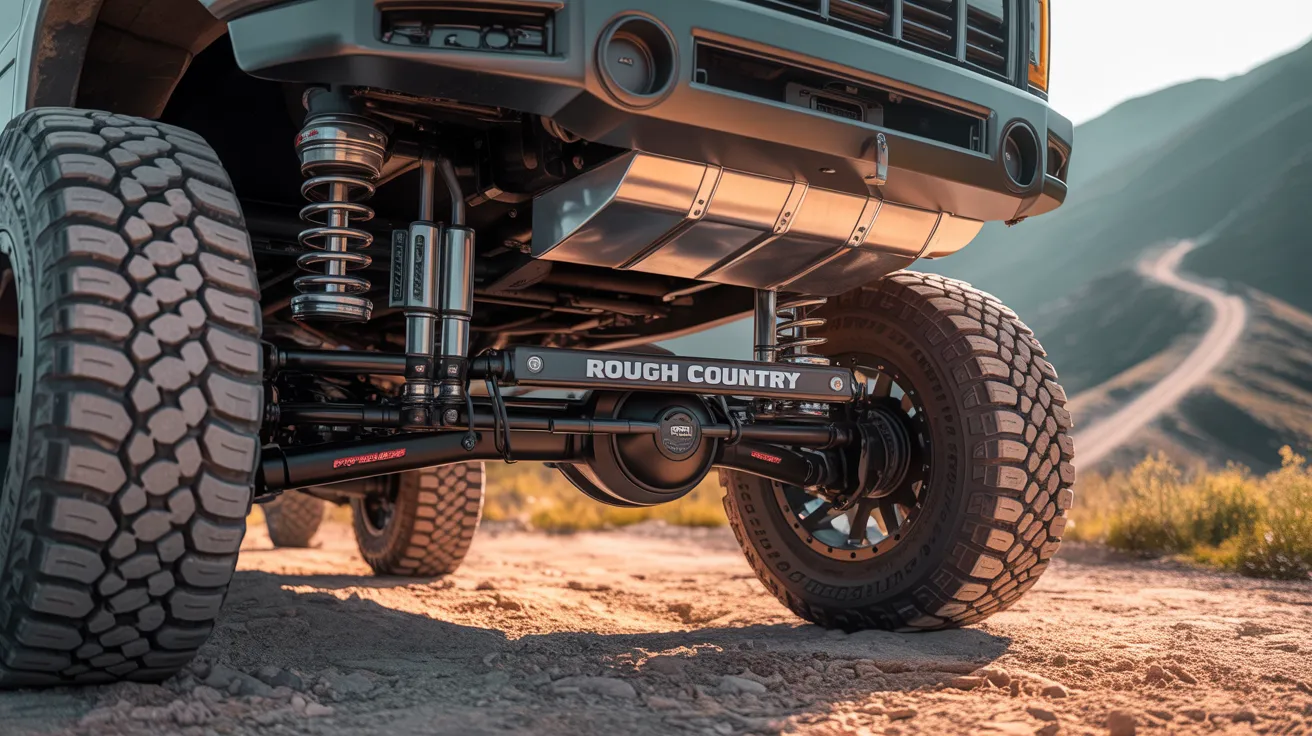
A suspension lift kit lifts the whole truck and revises important parts to create greater clearance and suspension travel. You'll see significant gains in ride height, off-road capability, and tire fitment, however you should expect handling tradeoffs, steering shifts, and an elevated center of gravity. If you prefer mild visual correction, apply a leveling kit. If you need real clearance and articulation, go with a suspension lift and structure the supporting modifications according to your use case.
Determine which Rough Country lift kit suits your truck.
To identify the right kit, start with your truck's year, make, and model, drivetrain, and planned application, because Rough Country builds lift kits around exact platform geometry and performance objectives. That baseline tells you which structural components and fasteners will actually mount correctly without fitment or alignment issues.
Then verify factory ride height, cabin and bed configuration, axle configuration, and if your truck has 2WD, 4WD, or adaptive suspension. Rough Country fitment resources help with this verification, although you should check component compatibility versus configuration-specific parts and factory package differences. A kit designed for a Silverado 1500 doesn't fit a Trail Boss, and a Ram featuring pneumatic suspension needs different adjustments than a vehicle with coil suspension. After checking fitment thoroughly, you prevent install surprises, compatibility issues, and reshipment delays.
Which Rough Country lift kit works with your driving habits?
Select the kit with your driving style, and you'll get improved ride comfort, lasting performance, and additional tire clearance without purchasing unnecessary capability. If your truck spends most days commuting, choose a light leveling kit from Rough Country or a 2 to 3.5 inch lift kit optimized for daily comfort and predictable steering behavior.
If your truck sees both pavement and trail time, go with a suspension system with upgraded shocks and optimized control arm positioning. You'll enjoy stronger off road handling, superior articulation, and room for larger tires without taxing original components. For heavy trail driving, select lifted struts, N3 or Vertex dampers, and lifts that maintain driveline geometry during compression. The correct Rough Country kit needs to match load, speed, terrain, and your tolerance for ride stiffness.
Leading Rough Country Truck Accessories
Round out your lift setup including Rough Country accessories that tackle the real weak points you'll notice after changing ride height, tire size, and vehicle stance. Start with new running boards or skid plates, that restore cabin access and provide side protection as your truck sits higher and wider.
Next, prioritize
How Much Should You Budget for Your Build?
After selecting discover this the lift kit and supporting accessories, set aside a budget beyond the headline kit price. You'll require funding for shock units, wheel sets, tires, alignment, work costs, and any drivetrain or steering corrections your vehicle type requires. Brand reputation counts; premium systems usually offer stricter specs, better ride quality, and easier installations.
Regarding realistic cost projections, anticipate basic spacer or leveling kits to start at lower prices, while comprehensive suspension packages with control arms, tuned dampers, and bigger tires increase fast. Install complexity, labor costs, and calibration work may contribute significantly. You should also price supporting upgrades like gear changes, brake components, and recovery gear if you're building for trail use. When budget is tight, assess financing options carefully and emphasize reliability over flashy add-ons.
Common Questions Answered
Will Lift Kits Change My Factory Warranty?
Yes, suspension kits can affect your original warranty, but they won't automatically cancel it. You encounter warranty issues if the dealer proves the lift kit caused or was involved in a failure. Powertrain, steering, suspension, and drivetrain claims often spark dealer disagreements. You ought to maintain installation records, choose quality parts, and follow service intervals. That helps you contest denied claims and maintain protection where the modification didn't cause the problem.
Do Bigger Tires Mean Re-Gearing?
Yes—if you jump multiple tire sizes, you'll usually require re-gearing. For example, when you move from 31s to 35s—your truck may feel underpowered, shift irregularly, plus create drivetrain pressure under load. Re-gearing bring back correct gear ratios, allowing you to get back acceleration, towing performance, and transmission behavior. You may not require it for a minor upsizing, but if performance, economy, or shifting decline, it's usually the right call.
How Frequently Should You Inspect Lift Parts?
You should inspect lift components after the first 500 miles, then each time you change oil or at 3,000 to 5,000 mile intervals, depending on your usage. Regular maintenance checks help you spot bushing wear, shock leaks, bracket damage, and alignment issues early. Verify fastener tightness after hard off-road runs, towing, or impacts. If you drive in mud, salt, or rough terrain often, shorten intervals and inspect suspension and steering parts at faster intervals.
How does a suspension kit affect your truck's towing and payload capacity?
Yes, a suspension kit can impact your towing and payload capacity. When you raise ride height for more ground clearance, you alter suspension geometry, center of gravity, and stress on parts. That can reduce stability under weight and boost drivetrain stress, especially with larger tires. You should follow your manufacturer's ratings unless an professionally designed kit specifically documents revised capacities. Correct alignment, gearing, and brake performance are important as well.
Is alignment work necessary after you install truck accessories?
Yes—if attachments alter height of ride, suspension structure, steering direction, or tire measurement, you must have an alignment. You'll witness the reality without delay: slight changes can force your truck off-center, scrub tread, and compromise handling. A quality alignment restores camber angle value, caster angle value, and toe to manufacturer spec. After certain installs, you may also need brake calibration for driver-assist accuracy. You extend tire lifespan, steering exactness, and real-world safety by confirming alignment straight away.
Summary
Determining the best suspension system and upgrades is based on your vehicle's purpose, your aesthetic choice, and what your budget can handle. When you connect a Rough Country lift kit to your driving preferences, you'll get strength, elevation, and visual appeal which synchronize as smoothly as a fine-tuned transmission. Incorporate smart accessories, manage your expenses thoughtfully, and you'll construct a automobile proving functional for daily use, capable off it, and positioned for upcoming challenges.